



New consumer research from Apkudo and FDM CCS Insight reveals that subjective grading labels like "Grade A" and "Like New" are actively eroding value across the refurbished device supply chain — a phenomenon the study names the confusion tax. When shown a transparent Device Passport™, 100% of focus group participants across the US and UK saw immediate commercial value, with multiple buyers saying they would not purchase a refurbished device without one again. Phase 2 of the research will quantify the financial scale of the transparency gap, putting a hard number on what the secondary market stands to recover.
Conversations have evolved. A few short years ago, secondary-market conversations were all about the warehouse—maximizing velocity, scaling throughput, and eliminating subjective manual touchpoints. Those operational metrics still matter.
But the industry has matured. Today, the strategic focus has shifted almost entirely to the end-consumer experience.
As an ecosystem, we have to answer two basic questions:
To get definitive answers, Apkudo recently partnered with the research analysts at FDM CCS Insight to conduct qualitative consumer focus groups across the US and UK. The early Phase 1 data, unveiled at our second Vanta Forum, fundamentally raises the standard for how global carriers, OEMs, and marketplaces must manage the next generation of refurbished device sales.
One of the most critical commercial concepts identified in our research is the confusion tax, the direct financial and behavioral toll inflicted on the refurbished device ecosystem because consumers do not know or trust what they are actually buying.
Subjective cosmetic descriptors such as "fair," "like new," and "Grade A" are ubiquitous in modern refurbished device listings. However, focus group participants across both regional test markets explicitly stated that they do not fully trust these labels. Because there is no unified industry calibration, consumers see these definitions as arbitrary and inconsistent across different commerce channels.
The Structural Reality: Cosmetic and functional device labels currently inherit the trust level of the seller, rather than their own intrinsic, objective meaning.
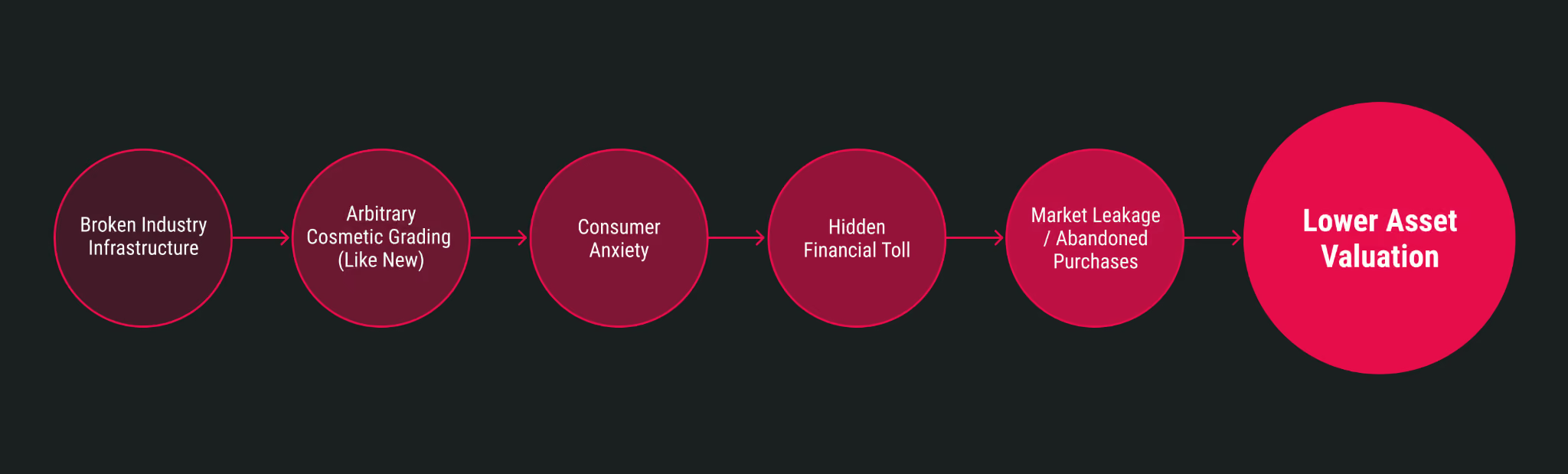
When focus group participants were asked unprompted to isolate what factors determine their confidence in a used device, four core operational vulnerabilities surfaced consistently:
When forced to prioritize, functional testing verification and true battery health are the non-negotiable thresholds for consumer acceptance. Everything else, even cosmetic condition grading, is secondary.
A key behavioral nuance emerged during testing: consumers claimed parts history was a minor detail, but the moment a transparent Device Passport™ prototype exposed the actual parts history, it instantly dictated their valuation of the device.
The definitive takeaway from our Phase 1 study was the market response to a structured, transparent Device Passport. When shown a verifiable record detailing an asset’s physical history, exact testing metrics, and mechanical components, 100% of respondents saw immediate commercial value.
The reaction was a fundamental paradigm shift. Multiple buyers noted that once they know this level of verifiable transparency is technically possible, they will hesitate to ever buy a device without a passport again.
"The device passport is the most important thing for me. I would not want to buy a phone without it now." — US Focus Group Participant
"Showing all these details up front highlights that the retailer is confident about their products, which makes it more trustworthy for me." — UK Focus Group Participant
While consumers overwhelmingly demand the transparency of a passport, they are deeply analytical of the data presented. To satisfy rigorous industry standards and enterprise buyer scrutiny, a device passport must fulfill three distinct structural requirements that emerged from the focus groups:
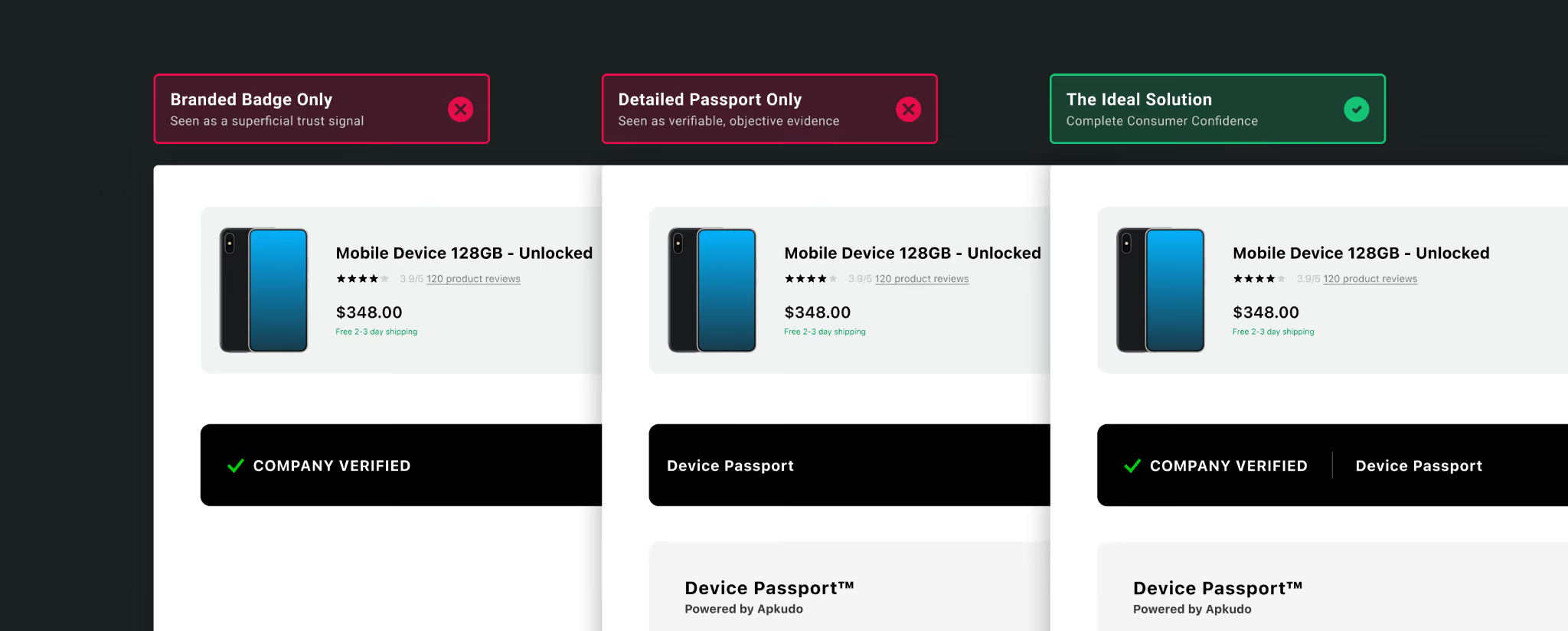
One of the most interesting insights from our Phase 1 focus groups with FDM CCS Insight is how consumers navigate trust markers. When evaluating used devices, manufacturer and OEM branding remains an incredibly powerful emotional trust signal.
However, when focus group participants were forced to choose between a standard branded badge and a detailed device passport, a clear behavioral shift occurred: consumers preferred the structural evidence of the passport over a standalone marketing badge.
Perhaps the most surprising finding from the qualitative focus groups was an underlying nervousness regarding how devices are evaluated.
When introduced to the concept of automated evaluation, respondents in both the US and the UK expressed distinct skepticism toward AI-led robotics over traditional manual processing. Simon Bryant captured this consumer mindset perfectly through a classic automotive analogy:
"It could be like with cars; if you said to somebody, 'Okay, we're going to have a robot look at your car or a qualified mechanic,' they would say, 'Oh, well, I want a qualified mechanic.'"
This presents a fascinating challenge. As a B2B industry, we know with absolute certainty that automation, machine learning, and robotics are the only viable paths forward to achieve the scale, processing efficiency, and objective accuracy required to handle millions of devices.
This qualitative feedback reveals that the industry has a massive consumer education gap to close. Consumers naturally associate a human touch with ‘expert care,’ unaware that human grading in the secondary electronics market is highly subjective, prone to error, and the root cause of the very ‘confusion tax’ they dislike.
Our job as an industry isn't to hide the technology layer. Rather, we must get better at communicating its direct consumer benefits, proving that software-driven, automated precision delivers a level of accuracy, safety, and verifiable trust that no human eye can match.
This qualitative analysis marks Phase 1 of our research project. By taking these focus group findings as a baseline, we are launching Phase 2, a quantitative study across markets to put hard numbers on the confusion tax and validate consumer demand for device passport information at scale.
Simon Bryant, VP Research at FDM CCS Insight, will join Apkudo CEO and Co-Founder Josh Matthews on stage at Mobile Disrupt to share qualitative insights from additional markets.
In the meantime, you can watch our Vanta Forum strategic presentation to learn how to prepare your supply chain infrastructure for an era built entirely on verifiable device truth.
Watch "The Transparency Premium: Quantifying the Value of a Trusted Device"

.avif)